Conversation-Level QA
We test whole conversations, not single replies. A bot that answers each turn correctly can still lose the thread across five turns, and that is the level we validate.
We test AI chatbots for the moments that break customer trust: missed intents, hallucinated answers, guardrail gaps and slow responses across every channel and language you support. You get clear evidence of what works, what fails, and what to fix before launch.
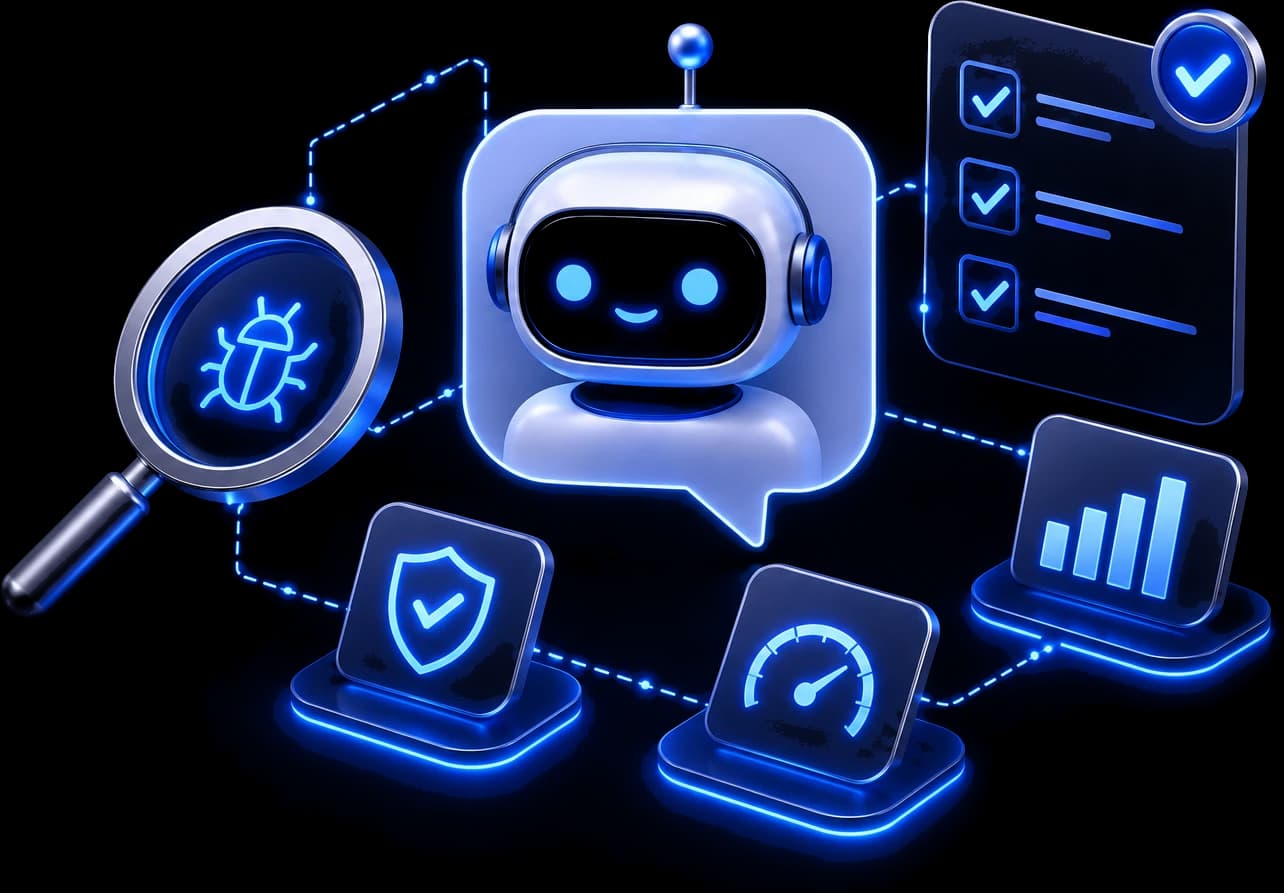





Chatbot testing services are structured programs that verify a conversational AI understands, responds and escalates the way your customers need. As part of our wider software testing and QA services, we cover the full conversation lifecycle, not just individual answers.
We test whole conversations, not single replies. A bot that answers each turn correctly can still lose the thread across five turns, and that is the level we validate.
LLM and RAG chatbots phrase every answer differently. We score responses against acceptance criteria for accuracy, grounding and tone, so variation is measured, not guessed at.
Web widgets, WhatsApp, in-app chat, and voice handoffs can make the same bot behave differently across channels. Our AI chatbot testing services verify that formatting, context, and user identity remain consistent across every channel you deploy.
Every model update, prompt change or knowledge-base refresh can silently break working flows. We re-run your critical journeys on a schedule so regressions surface before customers find them.
Most chatbot failures are invisible in a demo but become obvious at scale. According to the Zendesk CX Trends 2026 report, 85% of CX leaders say customers will abandon a brand over an unresolved issue, even after the first interaction. This makes the four chatbot testing areas below too important to ignore.
A customer types "cancel my last order" and the bot opens a subscription-cancellation flow. Close-but-wrong intent matches are the most common defect class we log.
The bot invents a refund policy, a price or a product feature with total confidence. Fluent, plausible and wrong is the failure mode unique to generative chatbots.
Three turns in, the bot forgets the order number the customer already gave and asks for it again. Context loss quietly doubles handle time and erodes trust.
A customer asks for a human four different ways, gets looped back to the menu each time, and abandons the channel. We test every escalation trigger and handoff, end to end.
Our chatbot QA testing spans eight coverage areas, from intent accuracy to accessibility. Each engagement combines automated pipelines with human evaluators, because conversational AI testing services need both scale and judgment. You choose the areas that match your risk profile; we scope the rest.
NLP and Intent Testing
We measure intent classification accuracy, entity extraction and confidence thresholds against a test set built from your real utterances, including typos, slang and mixed-language input.
Every engagement begins with a focused audit of your chatbot's highest-risk conversation journeys. Discover exactly what we'll test, why it matters, and the order in which we'll address each area.

Testing an AI chatbot well is a process, not a tool run. Ours moves from risk mapping to sign-off in six steps, and every step produces an artifact you keep: plans, prompts, scripts and reports all remain yours.
We map your bot's architecture, channels, intents and knowledge sources, then rank customer journeys by business risk. High-volume and high-stakes flows, such as those involving payments, cancellations, or health and account data, go to the top of the test order.
Chatbot testing deliverables should be specified before you sign, not discovered after. Every Futurize Labs engagement produces the same five artifacts, in the same format, so your team can act on the findings the day the report lands.
Every defect is classified into one of seven classes, from hallucination to latency breach, so patterns across releases become visible instead of anecdotal.
A one-page scorecard with defined metrics, how each was measured and a suggested launch threshold. No proprietary black-box score: you see the full rubric.
Each defect carries a severity tied to release impact: blocks launch, fix before scale, or monitor. Your engineers know exactly what to fix first.
Every logged defect includes the exact prompt, conversation state and channel that produced it, so your team can reproduce it in minutes, not days.
Resolved defects are retested and formally closed. The final report states what was fixed, what was accepted as a known risk, and by whom.
Regulated industries do not get to treat chatbot compliance as a legal-team afterthought. We map the obligations described in five major frameworks to specific, repeatable tests, so your bot's audit trail exists before a regulator asks for it.

General Data Protection Regulation

California Consumer Privacy Act

Governs lawful personal data handling.
System and Organization Controls Type II

Health Insurance Portability and Accountability Act
Want to see the defect taxonomy, scorecard and compliance matrix in a real report format? Request a redacted sample and judge the detail yourself.

Plenty of vendors will test your chatbot. What we sell is verifiable: independent findings, a published methodology, testers matched to your domain, and pricing agreed before work starts. Here is what that means in practice.
We do not build chatbots, resell platforms or take referral fees from tooling vendors. Our only deliverable is findings, so no incentive competes with your report.
Automated pipelines handle regression scale; human evaluators handle judgment, tone and adversarial creativity. Every engagement uses both, and the report shows which method found each defect.
Testers are assigned by domain: banking bots get testers who know KYC flows, healthcare bots get testers who understand PHI. Domain fit is written into your test plan.
We work in your stack, whether that is Botium, Playwright, custom LLM-as-judge harnesses or plain pytest, and hand over every script at the end, so nothing locks you in.
Every proposal states the coverage areas, test volumes and deliverables it includes, priced against the six drivers above. Scope changes are agreed in writing, never discovered on an invoice.
Your chatbot is answering customers right now, with or without evidence that it should be. A scoped audit gives you that evidence in weeks: what works, what fails, what to fix first, and the metrics that say you are ready to scale.

Chatbot testing is the structured evaluation of a conversational AI's accuracy, safety, performance and user experience, before and after launch. It covers whether the bot understands intent, gives grounded answers, protects data, escalates correctly and holds up under load. Unlike traditional software testing, it must handle non-deterministic outputs, where the same question can produce different valid answers, so responses are scored against acceptance criteria rather than exact matches.
Because the outputs are not deterministic. Traditional tests compare an actual result to a single expected result; an LLM chatbot can phrase a correct answer a hundred ways and a wrong answer just as fluently. Testing therefore needs semantic evaluation, grounding checks against source content, and human judgment for tone and safety. Add multiple channels, languages and constantly updating models, and the test surface grows far beyond a fixed regression suite.
We score responses against acceptance criteria instead of exact strings. Each test case defines what a correct answer must contain, must not contain, and which source it must be grounded in. Automated evaluators, including LLM-as-judge scoring, grade every response against those criteria, and human reviewers audit a sample for accuracy. Variation in phrasing passes; variation in facts, safety or required content fails.
Both, and the split matters. Automation handles what must run repeatedly: intent accuracy, regression suites, latency and grounding checks across thousands of prompts. Humans handle what automation cannot judge reliably: tone, cultural fit, creative jailbreak attempts and ambiguous multi-turn conversations. Fully automated testing misses judgment defects; fully manual testing cannot keep pace with weekly releases. Every engagement combines both, and the report shows which method found each defect.
We test grounding deliberately, in three passes. First, questions your knowledge base answers fully, where the bot must reflect that content accurately. Second, questions it cannot answer, where the bot must decline or escalate rather than improvise. Third, questions it can only half-answer, which is where most hallucinations live. Every fabricated claim is logged with the exact prompt, conversation state and severity, so your team can reproduce and fix it quickly.
When it clears defined thresholds, not when it feels good in a demo. Our readiness scorecard measures intent accuracy, grounded response rate, escalation success, context retention and response latency against launch thresholds agreed with you during planning. A bot is ready when every blocking defect is closed, retested and signed off, and every metric sits at or above its threshold, with the evidence documented in your report.
Yes. Multilingual testing is performed by native speakers in each target market, not by translating an English test script. Testers evaluate accuracy, but also formality, tone and cultural fit: the things machine translation misses and customers notice immediately. Market-specific scenarios, local regulation and regional data-handling expectations are built into the test plan, so a bot validated for a market is genuinely validated for that market.
Chatbot testing validates conversation: understanding, answering and escalating. AI agent testing validates action: an agent that books refunds, updates records or calls external tools needs its decisions, tool calls and side effects tested, which is a different discipline with different risks. This page covers chatbot testing; for autonomous, tool-using systems, see our AI agent testing services. If your bot both converses and acts, both scopes apply.